Frequently Asked Questions
Product Information
What is Bluebricks and what does it do?
Bluebricks is an IaC-agnostic environment orchestrator that transforms Infrastructure as Code (IaC), configurations, and scripts into one-click, AI-agent ready environments. It simplifies and streamlines cloud infrastructure operations, enabling rapid, consistent, and compliant environment creation for organizations of any size. [Source]
How does Bluebricks enable AI agents to manage cloud infrastructure?
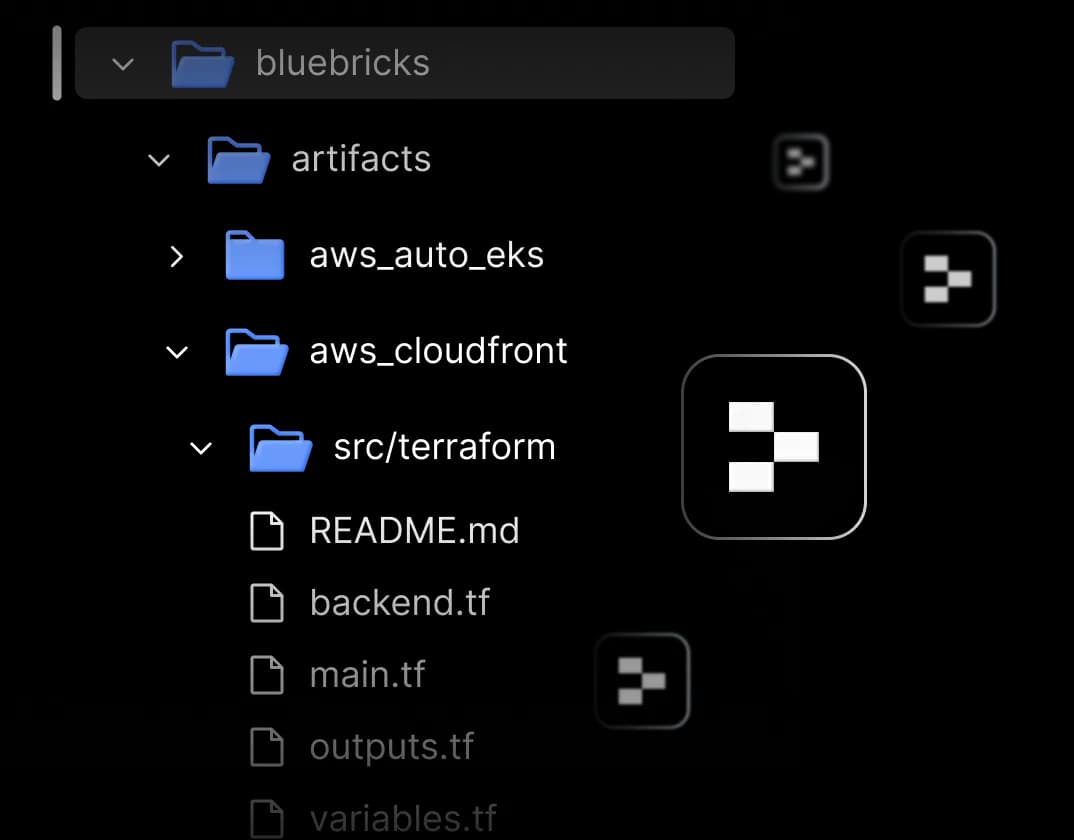
Bluebricks provides AI agents with deterministic context by automatically loading any IaC, configuration tool, or script from your Git repositories. It generates certified cloud infrastructure blueprint catalogs and supplies context from live configurations, cloud graphs, and deployment history, ensuring standardized and compliant deployments. [Source]
What is the primary purpose of Bluebricks?
The primary purpose of Bluebricks is to make distributed cloud simple and intuitive by providing one-click environment orchestration. It leverages Agentic AI to discover, package, and orchestrate any cloud environment, helping companies move fast, stay agile, and scale with confidence. [Source]
How does Bluebricks turn AI agent requests into real infrastructure changes?
Bluebricks uses governed orchestration that follows your organization's guardrails, permissions, and approval policies. This ensures that AI agent-initiated requests are executed in a compliant and secure manner. [Source]
What kind of infrastructure context does Bluebricks provide to AI agents?
Bluebricks provides a normalized, schema-driven representation of infrastructure, including dependency maps, histories, and allowed actions. This eliminates ambiguity for AI agents and ensures safe, standards-based operations. [Source]
How does Bluebricks use existing code and live configuration?
Bluebricks automatically loads any Infrastructure as Code (IaC), configuration tool, or script from your Git repositories to generate a certified blueprint catalog. It also provides AI agents with context from live configuration, cloud graphs, and deployment history. [Source]
What is the Bluebricks cloud graph?
The Bluebricks cloud graph is a real-time visual representation of your cloud infrastructure, used for discovery, auto-healing, and security vulnerability remediation. It is leveraged by and made for Agentic AI. [Source]
What types of environments can Bluebricks orchestrate?
Bluebricks can orchestrate any cloud environment, including hybrid, multi-cloud, and on-premises environments, using your existing IaC, configurations, and scripts. [Source]
How does Bluebricks support auto-scaling and cost optimization?
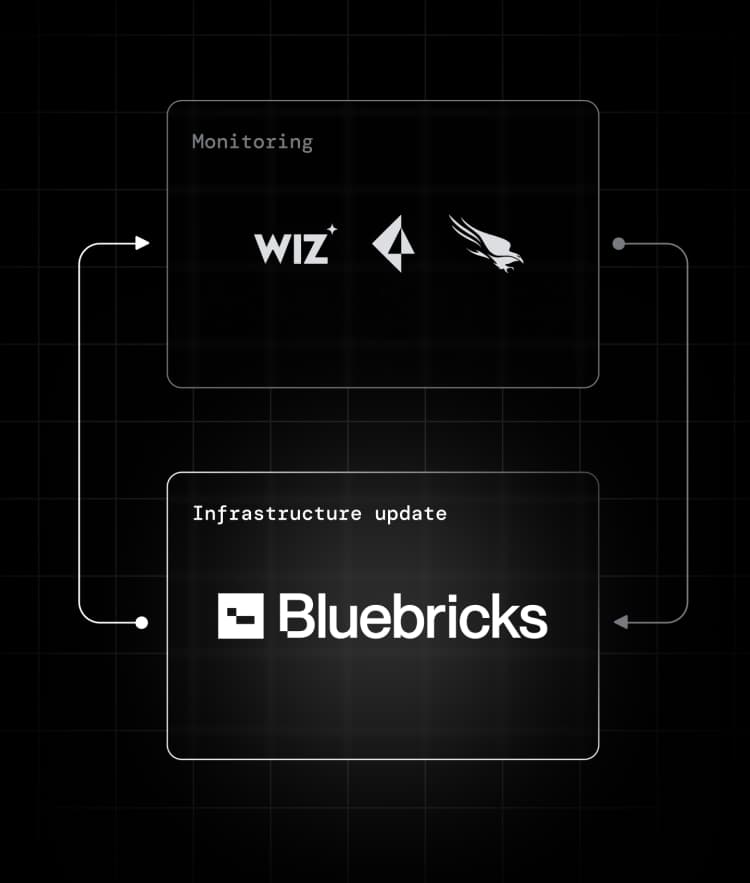
Bluebricks integrates with observability tools like Datadog and Coralogix, allowing AI agents to safely scale environments up or down, optimizing for cost without over- or under-provisioning. [Source]
What is Agentic AI in the context of Bluebricks?
Agentic AI refers to AI agents that can autonomously manage cloud infrastructure using the deterministic context, blueprints, and guardrails provided by Bluebricks. This enables safe, standards-based, and compliant automation of cloud operations. [Source]
Features & Capabilities
What are the key features of Bluebricks?
Key features include one-click environment orchestration, reusable blueprints, developer self-service, operational efficiency, AI integration, workflow management, security and compliance, observability, blast radius control, and rapid deployment (up to 80% faster than traditional methods). [Source]
Does Bluebricks support multiple Infrastructure as Code (IaC) tools?
Yes, Bluebricks is IaC-agnostic and supports multiple tools such as Terraform, Helm, Bicep, CloudFormation, and custom scripts, enabling seamless orchestration across diverse environments. [Source]
What integrations does Bluebricks offer?
Bluebricks integrates with source code management systems (GitHub, Bitbucket, GitLab, Azure DevOps), Slack, GitLab CI/CD, and major cloud providers (AWS, GCP, Oracle, Azure). These integrations streamline workflows and enhance productivity. [Slack Integration] [GitLab Integration]
Does Bluebricks provide an API?
Yes, Bluebricks offers a comprehensive API for programmatic access to its control plane, enabling automation and integration into your workflows. API documentation is available at https://bluebricks.co/docs/api/overview.
What technical documentation is available for Bluebricks?
Bluebricks provides extensive technical documentation, including an API reference, CLI installation guide, core concepts, knowledge base, and webhooks documentation. Access these resources at https://docs.bluebricks.co.
How does Bluebricks support developer self-service?
Bluebricks provides a user-friendly interface and ready-to-use environments, empowering developers to create secure, standards-aligned environments without writing IaC code or context switching. [Source]
What is Blast Radius Control in Bluebricks?
Blast Radius Control is a feature that minimizes risks during infrastructure changes, ensuring safer operations and reducing the impact of potential issues. [Source]
How does Bluebricks handle security and compliance?
Bluebricks is built with a 'Secure by Design' philosophy, supporting in-boundaries deployment, FIPS readiness, and compliance with ISO 27001, GDPR, and SOC 2. It enforces policies, manages roles, integrates with security tools, and maintains a comprehensive audit trail. [Trust Center]
What security certifications does Bluebricks have?
Bluebricks adheres to ISO 27001, GDPR, and SOC 2 certifications, ensuring robust data protection and compliance. More details are available at the Trust Center.
Pricing & Plans
What is Bluebricks' pricing model?
Bluebricks is licensed on a per-environment basis, providing clear and predictable pricing. For a personalized quote, visit the pricing page.
Use Cases & Benefits
Who can benefit from using Bluebricks?
Platform and DevOps teams, developers, organizations with decentralized locations, and enterprises concerned with compliance can all benefit from Bluebricks. It simplifies workflows, enables self-service, and ensures compliance across diverse environments. [Source]
What business impact can customers expect from Bluebricks?
Customers can expect improved efficiency, faster deployment (up to 80% faster), cost optimization, enhanced developer productivity, business continuity, scalability, flexibility, and risk reduction. [Source]
What core problems does Bluebricks solve?
Bluebricks addresses operational chaos, complexity in managing decentralized locations, developer infrastructure challenges, fragmented cloud operations, ease of implementation, and vendor lock-in concerns. [Source]
What pain points does Bluebricks address for its customers?
Bluebricks helps with operational chaos, slow and complex management of decentralized locations, developer delays, fragmented tools, and concerns about implementation time and vendor lock-in. [Source]
How quickly can Bluebricks be implemented?
Bluebricks can be set up in minutes, with customers typically up and running in days. There is no requirement for existing IaC coverage, making it accessible to organizations at any level of IaC maturity. [Source]
What customer feedback has Bluebricks received about ease of use?
Customers like Regev Golan (Check Point) and Nati Aviv (Head of DevOps and Infrastructure) have praised Bluebricks for making infrastructure management simple and effortless, highlighting its transformative impact and quick setup process. [Source]
Are there any case studies or success stories for Bluebricks?
Yes, Bluebricks has case studies in the film production industry and testimonials from customers like Check Point and Nati Aviv. Explore more at the case studies section.
Who are some of Bluebricks' customers?
Bluebricks is trusted by leading teams such as Checkpoint, Hibob, Milestone, Naviteq, Nutanix, Ness, and Gable. [Source]
Competition & Comparison
How does Bluebricks compare to Terragrunt?
Unlike Terragrunt, which only works with Terraform, Bluebricks supports multiple IaC tools, provides a user-friendly interface, offers full lifecycle orchestration (including Day-2 operations), centralized governance, real-time observability, and AI/ML enablement. [Source]
How does Bluebricks compare to Crossplane?
Bluebricks works with existing IaC tools, avoiding the need to rewrite infrastructure. It provides native automation for Day-2 operations, tool-agnostic workflow orchestration, centralized governance, and a real-time observability graph, which Crossplane does not natively offer. [Source]
What makes Bluebricks different from other environment orchestrators?
Bluebricks stands out with tool-agnostic workflows, full lifecycle orchestration, ease of use, centralized governance, real-time observability, AI/ML enablement, quick setup, and blast radius control. These features address the unique needs of different user segments and are not all available in competing solutions. [Source]
Why should a customer choose Bluebricks over alternatives?
Customers should choose Bluebricks for its tool-agnostic workflows, full lifecycle orchestration, ease of use, centralized governance, real-time observability, AI/ML enablement, quick setup, and blast radius control. These features provide a versatile and powerful solution for modern infrastructure needs. [Source]
Who are Bluebricks' main competitors?
Bluebricks' main competitors are Terragrunt and Crossplane. Terragrunt is a wrapper for Terraform, while Crossplane extends the Kubernetes control plane for infrastructure management. Bluebricks differentiates itself with tool-agnostic workflows, ease of use, and advanced governance and observability features. [Source]
Support & Implementation
What support resources are available for Bluebricks users?
Bluebricks offers email support ([email protected]), technical documentation (docs.bluebricks.co), and a knowledge base (help.bluebricks.co).
How easy is it to start using Bluebricks?
Bluebricks is designed for quick and easy implementation, with setup completed in minutes and no requirement for existing IaC coverage. This makes onboarding fast and accessible for teams of all technical backgrounds. [Source]
What industries are represented in Bluebricks' case studies?
Bluebricks has case studies in the film production industry. For more details, visit the case studies section.
What roles and companies are the primary target audience for Bluebricks?
Platform and DevOps teams are the primary users, and Bluebricks is designed for organizations that require standardized environment management across different clouds, teams, and regions. [Source]