Why AI Agents Can't Deploy Infrastructure (And How to Fix It)

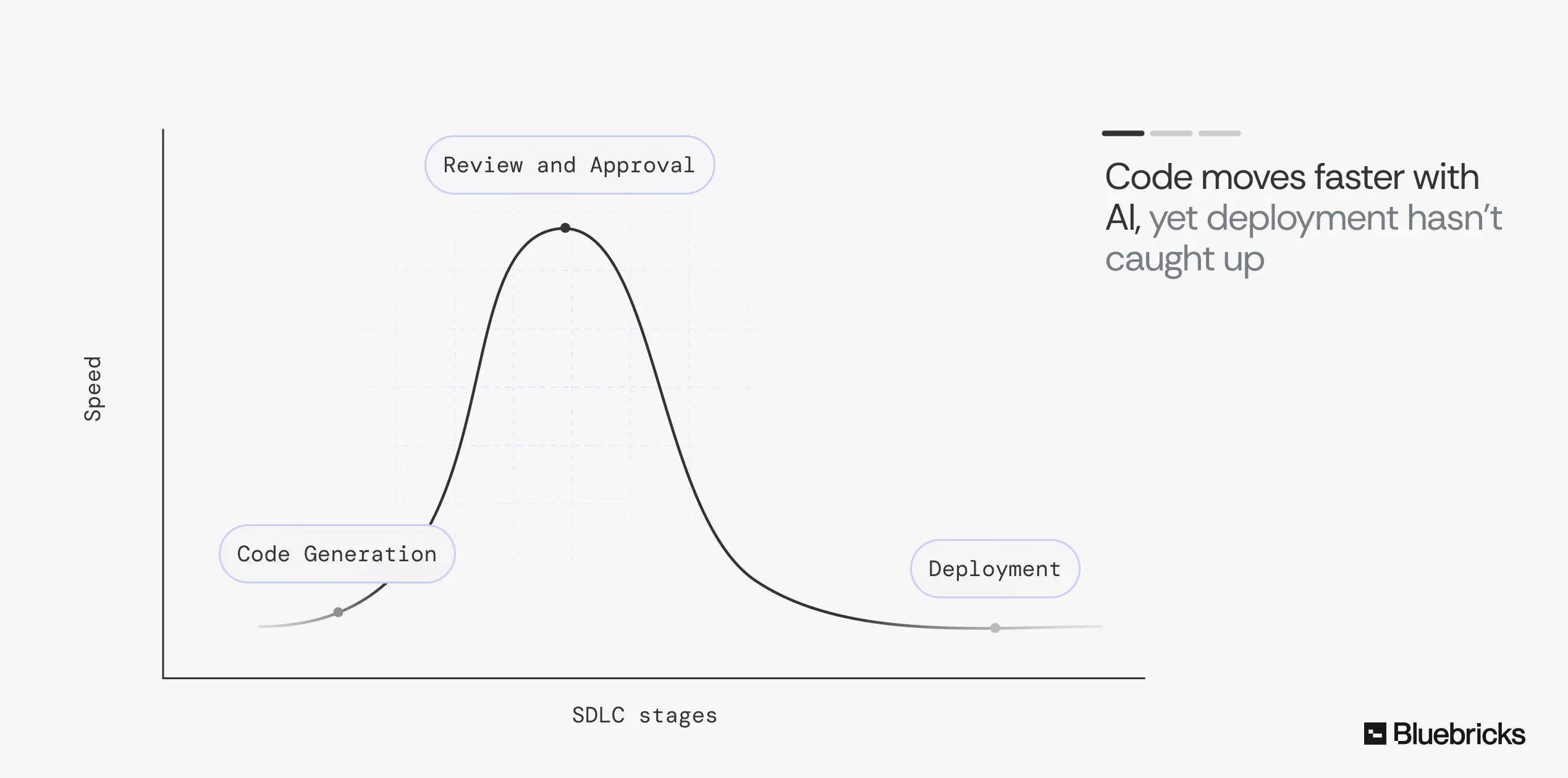
AI agents have accelerated code generation. They help developers write features faster, suggest implementations, and even assist with reviews. The result is more code, and more frequent shipping.
But while application pipelines have accelerated, infrastructure has not.
Developers need infrastructure to test, deploy, and scale that code. And it's not just about supporting new code. Infrastructure also needs to be deployed for disaster recovery scenarios, duplicated across regions to meet regulatory compliance requirements, and expanded to new locations to reduce latency for global users. Today, provisioning all these still gets stuck in ticket queues.
You might think the solution is obvious: use AI agents to write infrastructure code. But Infrastructure as Code is more than just writing configuration files. It's about understanding complex dependencies, orchestrating multiple technologies in the right sequence, applying organizational policies and standards, managing state, and making deployment decisions that align with business requirements.
What's really stopping AI from deploying safely
Lack of context and organizational knowledge
Every organization has unique requirements, policies, and architectural decisions that shape how infrastructure should be deployed. These aren't documented in code; they live in tribal knowledge spread across platform engineers, devops, SREs, and security teams.
Take a simple example: an IoT company wants to deploy a database. True, an AI agent will take seconds to generate the infrastructure code for an RDS instance. But real-world deployment isn't just spinning up a resource. It requires answering questions such as:
- Should the database be optimized for read-heavy or write-heavy loads?
- Does it need multi-region replication to meet business continuity goals, and if so, which policy?
And dozens of other organization-specific decisions.
An AI agent might output syntactically valid IaC, but without organizational context it risks deploying something misaligned, insecure, or non-compliant.
Complex technology stack and dependencies
An environment setup isn't just about Terraform. It's a stack of many layers that work together, enabling applications and services to run. A typical environment might include Terraform, helm charts, Python scripts and more.
AI agents today can help generate code for each of these technologies individually. The challenge comes at deployment time when all these pieces need to be orchestrated together.
Risk and compliance concerns
Perhaps the most critical barrier to using AI agents for deployment is risk. While generating infrastructure code is relatively safe, actual deployment carries immediate consequences: security breaches, compliance violations, cost overruns or even service outages.
AI agents don't have access to your organization's policies, compliance requirements, or risk thresholds. Without this knowledge built into their decision-making, AI agents become potential liability risks at deployment time.
This is why organizations are comfortable using AI to help generate code but are hesitant to let AI agents actually deploy that code without significant guardrails and controls.
What AI needs to deploy infrastructure
AI agents need clarity to deliver cloud infrastructure safely and consistently. That means:
- A controlled set of pre-approved options, not infinite possibilities
- Clear dependencies and deployment sequences
- Guardrails that enforce policies automatically
Without these, AI agents are just guessing, and infrastructure is too critical for guesswork.
This is where Bluebricks comes in.
Bluebricks converts any Infrastructure-as-Code, configuration tool, or script into immutable artifacts with normalized inputs and outputs. From these artifacts, engineers or AI agents can assemble blueprints, standardized deployment packages aligned with system and organizational requirements.
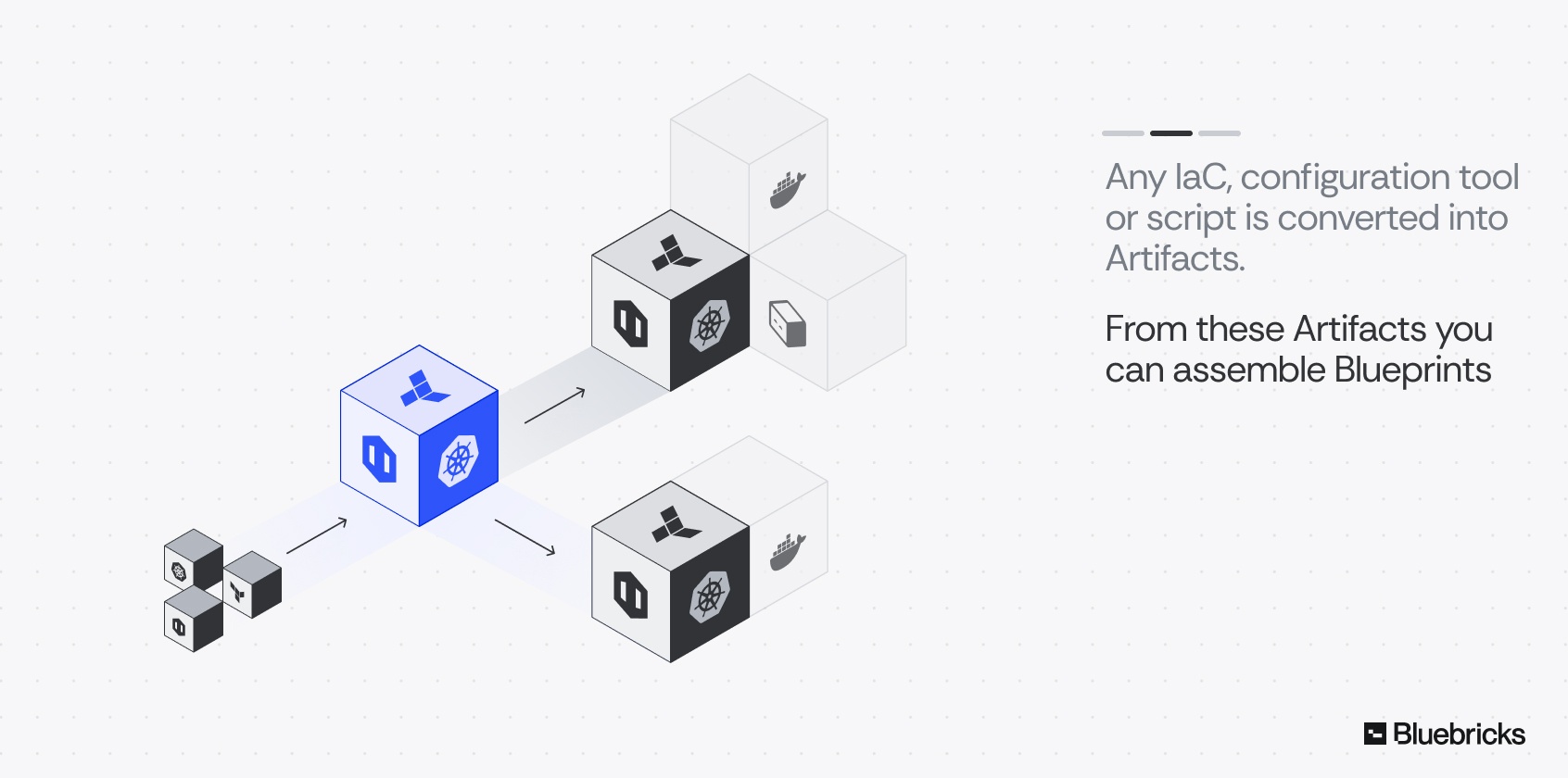
When a blueprint is executed, Bluebricks automatically builds a Directed Acyclic Graph (DAG) of dependencies, runs the underlying code, and enforces your policies, cost constraints, and approval workflows. The result is infrastructure that's delivered quickly, safely, and in full compliance with organizational standards
Let's dive in.
Pre-approved Blueprints catalog
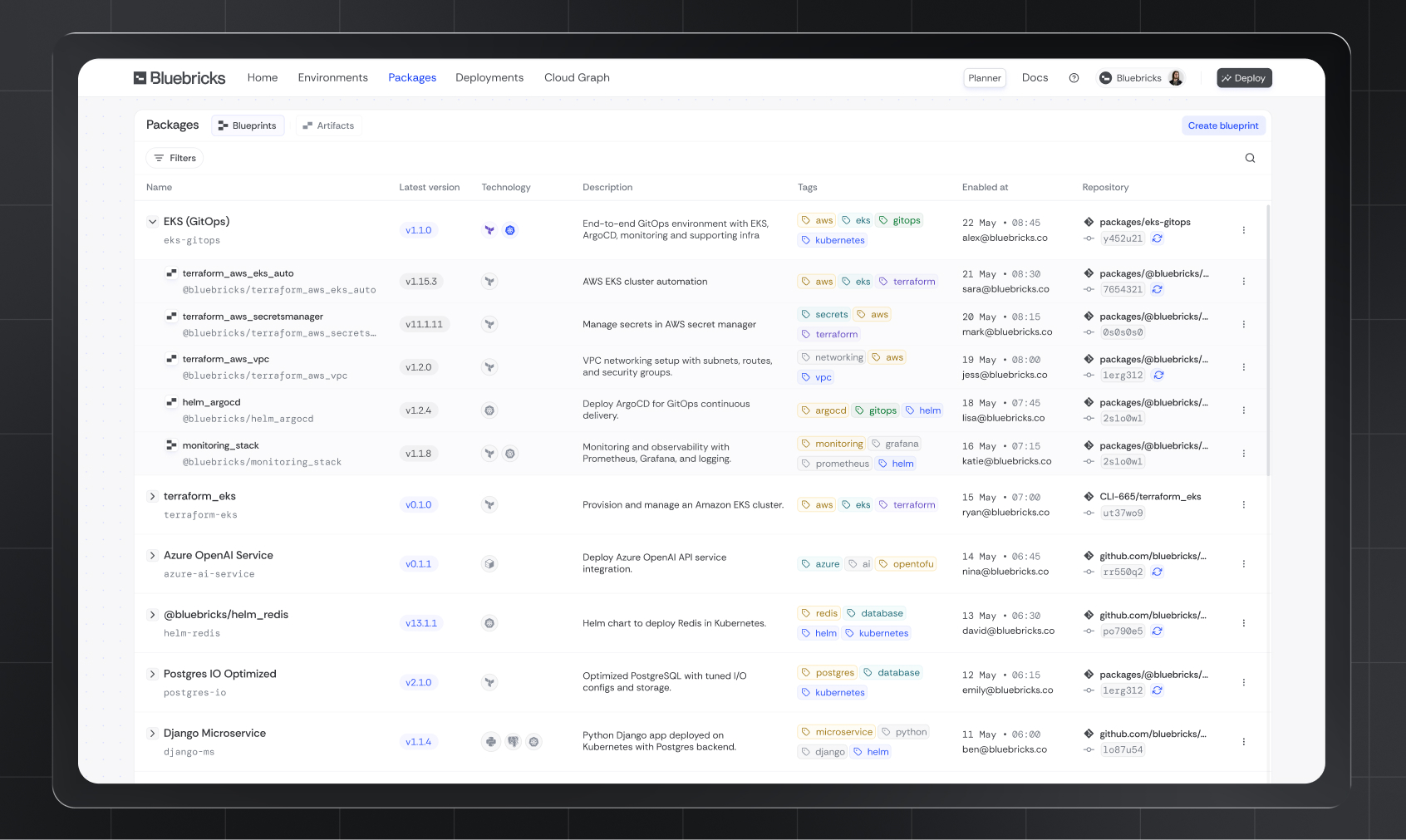
Bluebricks Blueprints form a pre-approved catalog, the single source of truth for how infrastructure gets deployed in an organization. Through Bluebricks' MCP server, AI agents gain direct access to this catalog and immediate clarity on:
- Which services and configurations are approved for use
- Which parameters and defaults are safe to apply
- How components depend on one another in the deployment flow
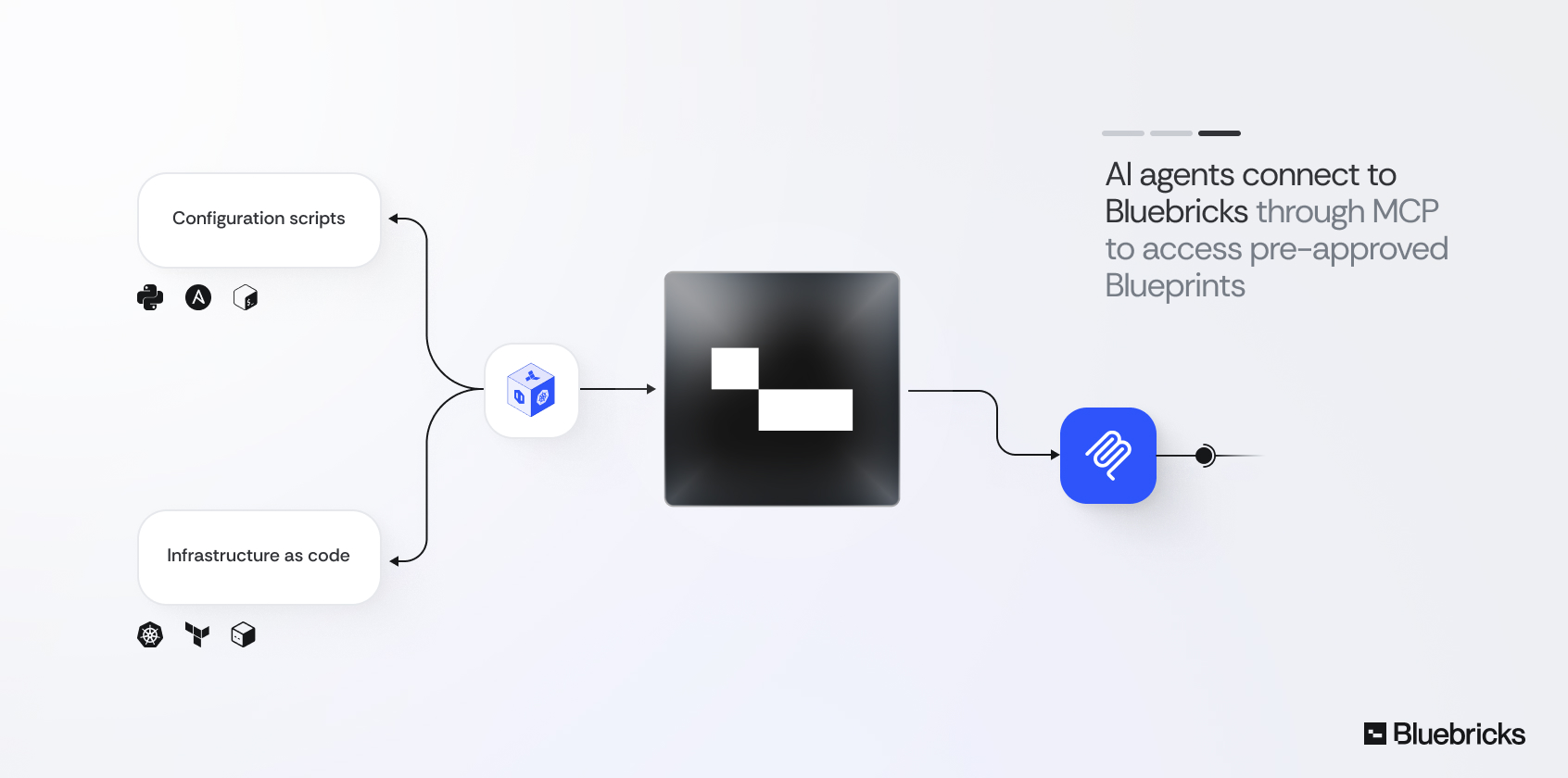
A developer request such as "I need a staging environment" maps directly to a certified blueprint that includes networking, security, Kubernetes cluster, and database components, all deployed according to organizational standards for staging.
The AI agent now has a controlled set of options to choose from, turning an overwhelming decision space into manageable, pre-validated choices.
Built-in organizational guardrails
Access to blueprints is just the start. The real power comes from their built-in guardrails. With Bluebricks, your DevOps team defines standards once, and Bluebricks bakes them into every blueprint. Now when AI agents deploy, they automatically follow your rules. Blueprints can enforce anything from cost controls to security policies, or compliance requirements.
Version control adds another layer of deployment safety. Each blueprint has a specific version with tested, validated configurations. When an AI agent helps deploy version 2.3 of your database blueprint, you know exactly what's being deployed.
Human-approved when needed
Not every deployment should be fully automated. Bluebricks lets you decide when humans should review AI-assisted deployments.
Set approval rules based on what matters to your org:
- Environment criticality (development vs. production)
- Blast radius (number of affected resources)
- Cost implications
- Compliance requirements
Before any deployment, Bluebricks shows you exactly what will change and the potential impact, making it easy for reviewers to quickly approve or reject changes with full context.
This means you can start conservative, and increase AI involvement as you build trust. Find the balance between speed and control that works for you.
Where AI-powered infrastructure makes sense
Not every infrastructure task needs AI. Manual provisioning works fine for one-off setups or highly custom configurations. AI delivers value when you need autonomous decisions at scale, triggered responses to events, or rapid provisioning based on contextual patterns.
Here are a few examples where AI agents excel within Bluebricks' guardrails:
Elastic scaling based on monitoring
One of the most practical applications is AI-assisted scaling based on monitoring alerts. When your monitoring system detects increasing load, it can trigger an AI agent through Bluebricks to help scale infrastructure accordingly.
With Bluebricks, the agent doesn't just scale, it makes intelligent decisions about how to scale. Scale out for memory-intensive workloads, scale up for CPU bottlenecks. Choose Spot instances during off-peak hours for cost optimization, or dedicated instances for critical business periods.
The agent evaluates the specific metric that triggered the alert, considers time-based patterns, cost implications, and then selects the appropriate scaling blueprint. All while acting within your defined limits and compliance requirements.
Developer self-service
Another immediately valuable use case is AI-assisted developer self-service. Instead of developers filing tickets and waiting days for infrastructure teams to provision resources, developers can request what they need in natural language, with AI agents helping to fulfill these requests within defined guardrails.
"I need a staging environment for testing the payment service" becomes a provisioned environment in minutes instead of days.
The AI agent:
- Identifies the appropriate blueprints for a payment service environment
- Configures the resources according to staging environment policies
- Sets up all dependencies and connections
- Provides connection details and documentation
The entire process happens within the safety of pre-approved blueprints and policies. Developers get the speed they need to match their development pace, while platform teams maintain control and compliance.
Key benefits
Faster deployments: With AI agents assisting deployment through Bluebricks, the gap between feature creation and infrastructure deployment narrows significantly. What used to be a days-long bottleneck becomes a manageable part of the flow.
Reduced risk: Standardized blueprints mean predictable outcomes. Every deployment follows the same patterns, uses the same configurations, and respects the same policies. The blast radius of any change is known before deployment, and changes only affect intended resources. This predictability makes it safe to involve AI agents in the deployment process.
Intelligent resource management: AI agents can make smart provisioning decisions within cost constraints. Resources scale based on actual need, while policy controls prevent runaway costs. The combination of AI decision-making and policy guardrails optimizes both performance and spending.
These benefits aren't just incremental improvements, they represent a fundamental shift in how infrastructure gets delivered.
The Future of DevOps with AI
AI agents have already changed how developers write and review code. The next step is bringing that same acceleration to infrastructure and platform engineering, safely. Left on their own, AI agents lack the context, policies, and orchestration needed to deliver cloud infrastructure reliably. That's why organizations hesitate to let them deploy.
Bluebricks provides the missing piece: a framework of certified assets. With this foundation, AI agents can help close the gap between code and infrastructure, turning requests into compliant, production-ready environments in minutes.
In this future, platform and DevOps teams become more strategic. They capture organizational knowledge in blueprints, while AI agents handle execution within those boundaries, delivering infrastructure that is not only fast and automated, but also aligned with compliance, security, and business requirements.
Ready to close the environment deployment gap? Book a demo to see how Bluebricks finally gets AI agents from code to production.